
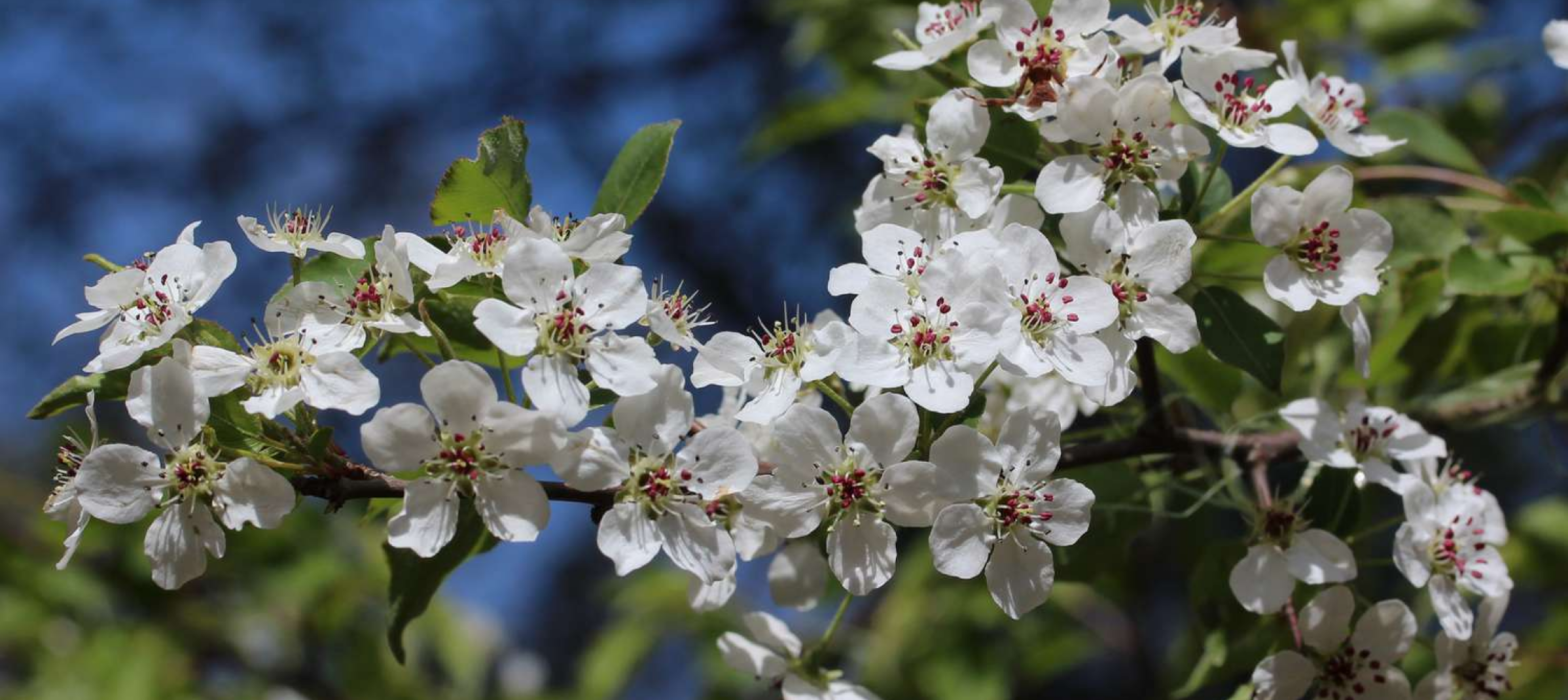
The Callery pear looked like the perfect street tree. It turned out to be one of the most damaging invasive
trees on Long Island — and New York is still selling it.
Why Long Island Needs to Pay Attention
Every April, white-blooming trees line Long Island’s strip mall parking lots, highway medians, and village traffic circles. Many of them are Bradford pears — a cultivar of the Callery pear (Pyrus calleryana). They smell like rotting fish when in bloom. More importantly, they’re quietly colonizing our roadsides, Pine Barrens edges, and remaining open land.
Ohio, Pennsylvania, South Carolina, Missouri, and New Jersey have all moved to ban or restrict Callery pear sales. New York has not. You can still walk into a Long Island garden center this weekend and buy one.
This is the story of how that happened — and what Long Island homeowners, landscapers, and local officials can do about it.
What Is the Callery Pear — and How Did It End Up Everywhere?
Pyrus calleryana is native to East Asia. The USDA imported it in the early 20th century as rootstock to breed fire blight resistance into the European pear industry — not for landscaping.
That changed in the 1960s, when the “Bradford” cultivar was selected at a USDA station in Maryland as a street tree. It was compact, fast-growing, and remarkably tolerant of urban punishment: compacted soil, road salt, drought, pollution. It grew fast enough to make a new subdivision look established overnight. For developers and municipalities, it was irresistible.
By the time the horticultural trade recognized the problem, Bradford pear had become America’s most-planted street tree.
How Bradford Pear Became Invasive: The Sterility That Wasn’t
Bradford pear was marketed as sterile — safe to plant because it supposedly couldn’t reproduce. That turned out to be only half true. A single Bradford can’t pollinate itself, but as more cultivars entered the market — Chanticleer, Cleveland Select, Aristocrat, Autumn Blaze — they cross-pollinated each other freely.
Birds ate the small, hard fruits through winter and scattered seeds across old fields, utility corridors, and forest edges. The offspring reverted to the wild Callery type: aggressive, genetically diverse, and armed with thorns long enough to puncture a tractor tire.
Look out any Long Island Rail Road window this April. The pillowy white thickets blanketing abandoned lots and roadside strips from Hicksville to Riverhead aren’t wildflowers. They’re Callery pear seedlings — and they’re spreading.
The Ecological Damage: What Callery Pear Is Actually Doing
It supports almost no native wildlife.
University of Delaware researcher Doug Tallamy has put hard numbers to the problem: a native oak supports around 500 species of moth and butterfly caterpillars; a native black cherry, over 300. A Callery pear supports essentially none.
Caterpillars are the protein base of the songbird food web. A chickadee pair needs roughly 6,000 to 9,000 caterpillars to raise a single clutch. A forest edge dominated by Callery pear is, to a breeding warbler, a desert dressed up as landscape.
It splits apart on a schedule.
The Bradford’s signature tight, upright branching creates weak union points that can’t support the tree’s own mature weight. Between years 15 and 25, Bradford pears split — usually in the first serious wind or ice storm after reaching full size. Every municipal forester in the Northeast has pulled Bradford limbs off cars and rooftops. The community plants it once, then pays again to chainsaw the wreckage.
It colonizes Long Island’s most valuable transitional habitats.
Those thorny Callery pear thickets take hold in old fields, hedgerows, and forest edges — the transitional zones between grassland and woodland that support the greatest density of wildlife on Long Island. Once established, they’re extremely difficult to remove.
Why Is It Still Being Sold? Six Reasons.
The evidence against Callery pear has been clear for over a decade. Here’s why it’s still on the
shelves.
- Nursery economics. Callery pear is cheap to produce and sells itself in bloom. It’s a profitable product with decades of wholesale infrastructure behind it.
- Spec inertia. Landscape plans from 20 years ago specified Bradford pear. Those plans became templates. Municipal planting lists and commercial site plans absorbed it as a default that rarely gets questioned.
- Plant blindness. Most people can’t distinguish a Callery pear from a serviceberry or dogwood in bloom. When we can’t see the species, we can’t build the will to change it.
- HOA aesthetics. Homeowner associations reward uniformity. Callery pear delivers the mass-produced sameness that reads as “neat.” Native alternatives grow with seasonal character that reads, to the untrained eye, as “messy.”
- Short political time horizons. A newly planted Callery pear takes 10–15 years to begin invading surrounding landscapes in measurable volume. No elected official’s term reaches that far. The damage gets passed to the next generation.
- “But my tree isn’t the problem.” It is. Every Bradford cross-pollinates every neighboring Chanticleer. On Long Island, there is no isolated landscape. The only way to stop the seed rain is to stop the planting.
Every State Around Us Has Acted. New York Hasn’t.
The regional picture is stark. Ohio banned Callery pear sales in 2023. South Carolina’s ban took effect in October 2024. Pennsylvania phased in its ban beginning in 2024. Missouri passed legislation in 2025. New Jersey signed the Invasive Species Management Act on the final day of the Murphy administration, banning Bradford pear sales across the Hudson.
New York State’s Part 575 invasive species list, finalized in 2014, does not include Pyrus calleryana. Our regional invasive species management effort can publish fact sheets, but it cannot stop a Suffolk County nursery from selling Bradford pears to a developer Monday morning.
We are, functionally, the last northeastern holdout still subsidizing the problem.”
Native Alternatives to Bradford Pear for Long Island Landscaping
Long Island has a deep bench of native flowering trees that fill every niche Callery pear occupies — with far greater ecological value and no invasive downside.
- Serviceberry (Amelanchier canadensis, A. arborea). White April flowers, edible June berries beloved by cedar waxwings and catbirds, brilliant orange-red fall color. The most direct replacement for Bradford pear.
- Eastern Redbud (Cercis canadensis). Magenta flowers emerging directly from the branches in April, heart-shaped leaves, supports native leafcutter bees.
- Flowering Dogwood (Cornus florida). The native species — not Asian kousa. A host plant for the spring azure butterfly and a keystone understory tree across eastern woodlands.
- Beach Plum (Prunus maritima). A South Shore heritage species. Part of a genus that hosts more than 400 native caterpillar species — and produces a celebrated local jam.
- Hawthorns (Crataegus spp.). Underused and underrated. Dense wildlife cover, protective nesting structure for birds, and four-season visual interest.
- Fringe Tree (Chionanthus virginicus). Spectacular white lace flowers in spring, a magnet for pollinators, and one of the most striking native trees available for Long Island yards.
Every one of these grows in a Long Island parking lot island, a village traffic circle, or a front yard that currently holds a Callery pear. The argument that there’s no alternative is not an argument. It’s a habit.
What Long Island Homeowners, Landscapers, and Officials Can Do
- Village boards, planning boards, HOAs, and school grounds committees: remove Callery pear from your approved planting list this season. Replace it with serviceberry, redbud, or dogwood.
- Landscape architects and landscapers: stop specifying it. Make the native swap on every plan. Your clients will thank you in year 15 when their tree doesn’t split in half.
- Nursery owners: sunset the inventory on your own timeline before regulators do it for you — and invest in the native stock that will replace it.
- Long Island homeowners: enjoy the bloom this April. Then call a removal service and plant a serviceberry in its place.
- Support New York State action: Pyrus calleryana belongs on the Part 575 prohibited list. Contact your state representative and say so.
Help Long Island Conservancy Remove the Invasive
Long Island Conservancy’s Dirty Dozen campaign identifies the twelve invasive plant species doing the most damage to Long Island’s trees, yards, parks, and waterways — and gives residents the tools to fight back. Callery pear is on the list.
To download the free Dirty Dozen guide, find native plant sources, or get involved in local restoration, visit longislandconservancy.org.
Plant native. Remove the invasive. Conserve our lands.