
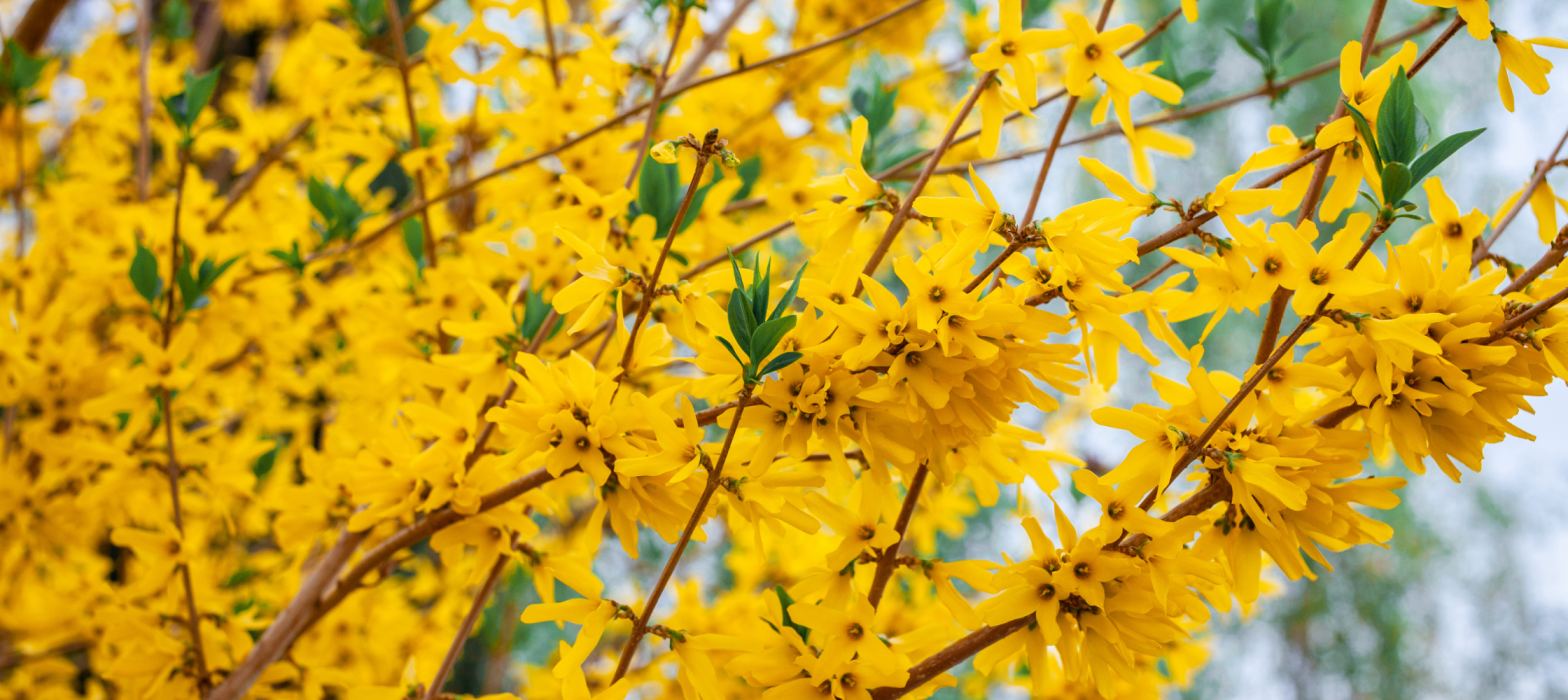
Every spring, Long Island bursts yellow with forsythia — but here’s what those cheerful blooms are actually doing to our native landscape.
Why Long Island Gardeners Should Care
Long Island is home to more than 8 million people, 1,100 miles of coastline, and a single underground aquifer that supplies our drinking water. Our remaining woodlands and woodland edges are under constant pressure — and forsythia, one of the most-planted shrubs on the Island, is quietly making things worse.
The good news: there’s a native alternative that blooms at the same time, looks just as beautiful, and actually supports the birds, butterflies, and bees that forsythia starves. Read on.
What Is Forsythia — and Where Did It Come From?
Forsythia is native to China and parts of southeastern Europe. It arrived in the United States through the Arnold Arboretum of Harvard University in 1889 and was quickly embraced by the nursery industry for its easy care and dramatic early-spring color.
Today it’s one of the best-selling shrubs in America — and one of the most problematic invasive trees and shrubs on Long Island.
How Forsythia Spreads (And Why It’s So Hard to Remove)
Forsythia is stoloniferous — meaning when a branch tip touches the ground, it roots and starts a new plant. Those roots run deep. Remove a forsythia and leave even part of the taproot, and it grows back.
“Forsythia is considered invasive as it is stoloniferous and extremely difficult to remove, as I can personally attest.”— Carolyn Summers, Designing Gardens With Flora of the American East
Once forsythia escapes a garden — and it does, pushed by roadsides, crept into vacant lots, spread into woodland edges — it forms dense thickets that crowd out whatever was growing before.
“Perhaps you’ve noticed that nothing will grow under forsythia?”— Carolyn Summers
That’s not a coincidence. It’s the mechanism of invasion.
So Why Is It Still Being Sold at Long Island Nurseries?
New York State has a framework for regulating invasive plants — but forsythia isn’t on it. It can be sold at any garden center or big-box store with no warning label whatsoever.
A 2021 peer-reviewed study in Frontiers in Ecology and the Environment found that 61% of 1,285 plant species identified as invasive in the U.S. remain available through the plant trade — including 50% of state-regulated species. The nursery industry is, in fact, the primary pathway for invasive plant introduction.
Forsythia stays on shelves because it’s pretty, easy, and in demand. Until regulations change, it’s up to Long Island homeowners to make different choices.
The Ecological Harm: What Forsythia Is Actually Doing
It creates a biological desert beneath it.
Forsythia thickets shade out native spring wildflowers, ferns, seedling trees, and low shrubs. What looks like a cheerful splash of yellow is, ecologically, a green silence.
It tricks early bees — and gives them nothing.
Forsythia blooms early and attracts bees, but it doesn’t produce pollen. A queen bumblebee emerging from winter hibernation expends precious energy visiting those flowers and gets nothing in return. Forsythia is ecological false advertising — and it crowds out the plants that would actually feed those bees.
It supports almost no native wildlife.
Native plants and native insects have co-evolved over thousands to millions of years. Forsythia arrived from Asia in 1889 — not enough time for any meaningful ecological relationship to develop. When it displaces native plants, it actively removes the food and habitat that wildlife depends on.
It’s pushing out one of Long Island’s most valuable native shrubs.
The plant forsythia most commonly displaces is spicebush (Lindera benzoin) — and the ecological difference between the two couldn’t be greater.
The Best Native Alternative: Plant Spicebush Instead
Spicebush blooms at the same time as forsythia, with small yellow flowers that light up the woodland edge before the leaves emerge. But ecologically, it’s in a different league entirely.
What spicebush supports on Long Island:
- Host plant for Spicebush Swallowtail and Eastern Tiger Swallowtail butterflies
- Larval host for Promethea Moth and several other moth species
- High-fat red berries in late summer that fuel migrating birds, including robins, thrushes, vireos, and White-Throated Sparrows
- Food source for raccoons, opossums, and squirrels
- Spectacular yellow fall foliage
You gain the spring color. You gain summer berries. You gain fall foliage. You gain butterflies and birds. What you give up is a plant that, for all its beauty, is the horticultural equivalent of a fast food restaurant: flashy, ubiquitous, and ecologically empty.
What Long Island Homeowners Can Do Right Now
Removing established forsythia is genuinely hard work — it won’t happen in a weekend. But you can start today.
- Stop the spread. Cut back any stems touching the ground. Bag and dispose of cuttings — do not compost them.
- Plant spicebush nearby. As your spicebush establishes over a few years, gradually remove forsythia sections and replace them one plant at a time.
- Don’t buy more forsythia. The next time you’re at a Long Island nursery and you see those cheerful yellow pots, ask for spicebush instead. If they don’t carry it, ask them why. That question, asked enough times, changes what nurseries stock.
- Learn the Dirty Dozen. Long Island Conservancy’s Dirty Dozen campaign identifies the twelve invasive plant species doing the most damage to Long Island’s trees, yards, parks, and waterways — and gives residents tools to fight back. Download the free guide at longislandconservancy.org.
How You Can Help Restore Long Island’s Native Landscape
Long Island’s native woodland edges once hummed with a complexity of life we can barely imagine today. Spicebush was part of that world. Forsythia was not.
The Long Island Conservancy advocates for native plant restoration and ecological stewardship from the East River to Montauk Point. To find native spicebush sources, learn about our Dirty Dozen campaign, or get involved in local restoration, visit us at longislandconservancy.org.
Plant native. Remove the invasive. Conserve our lands.
Sources & Further Reading
1. Town of Natick, MA — Forsythia
2. Sustainable Saratoga — Replace Your Invasives with Keystone Plants
3. Nature Center at Greenburgh — Forsythia Archives
4. Highlands Current — Roots and Shoots: Forsythia — Friend or Foe?
5. NY State DEC — Invasive Species Regulations
6. Nature Center at Greenburgh — What Not to Plant
7. Beaury et al. (2021) — Invaders for Sale — Frontiers in Ecology
8. The Natural Web — Spicebush or Forsythia?
9. Gardeninacity — Spicebush and Forsythia
10. University of Maryland Extension — Spicebush
11. Backyard Ecology — Spicebush