
Long Island has one of the heaviest tick-borne disease burdens in the country. Suffolk County alone reports hundreds of confirmed Lyme cases each year, alongside steady caseloads of babesiosis, anaplasmosis, and ehrlichiosis, and — more recently — a growing tail of alpha-gal syndrome and surveillance signals for emerging Heartland and Bourbon viruses. 1Our public health response has been built almost entirely around personal vigilance: long pants, permethrin, daily tick checks. That work matters. But it leaves out the part of the story that nature has been telling us for decades.
The story starts with a mouse.
The white-footed mouse (Peromyscus leucopus) is the single most important reservoir of Borrelia burgdorferi, the bacterium that causes Lyme disease.2 When a juvenile black-legged tick takes its first blood meal from an infected mouse, it picks up the spirochete and carries it forward into its next life stage — where it might find you, your dog, or your child. Together with eastern chipmunks and short-tailed shrews, white-footed mice are responsible for infecting roughly 80 to 90 percent of the ticks that go on to bite humans.3 These same mice also carry the pathogens behind babesiosis and anaplasmosis. Reduce the mice, and you reduce the disease — not just Lyme, but the whole rogues’ gallery of co-infections.
This is where foxes change the math.
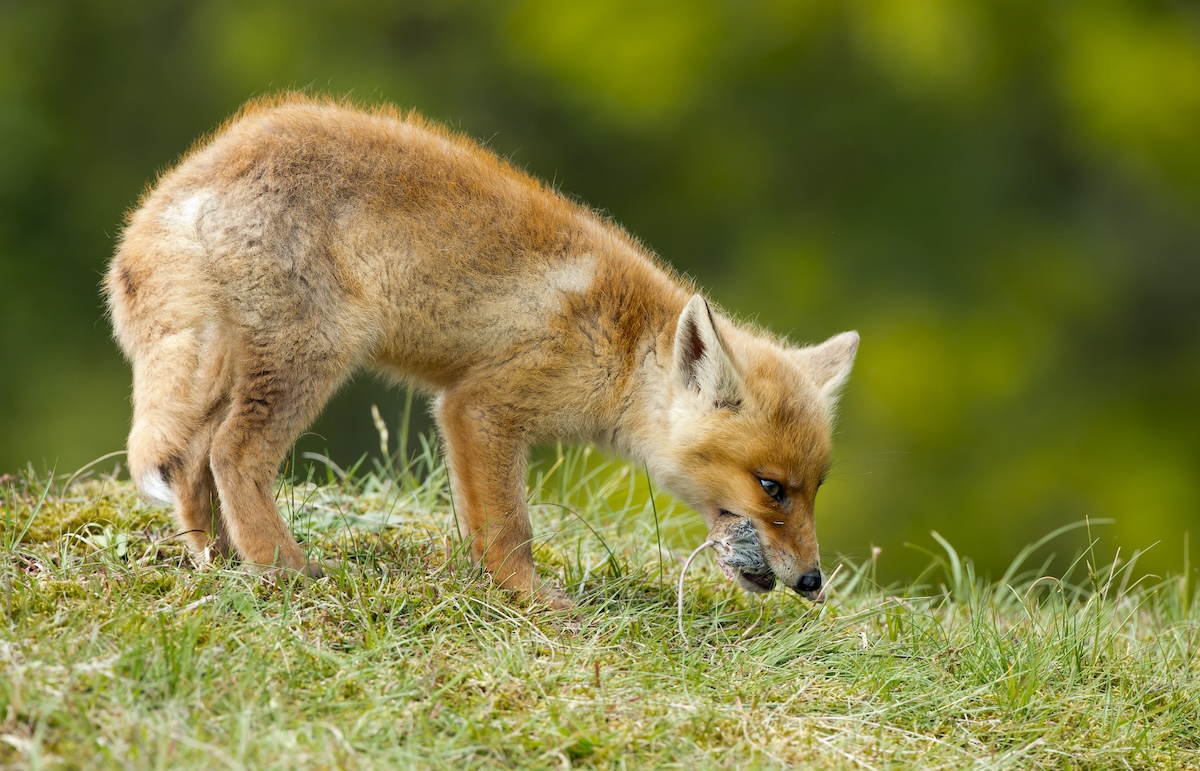
A red fox is, pound for pound, one of the most lethal small-mammal predators on the continent. Where given the chance, foxes occur at densities roughly an order of magnitude higher than coyotes, and small mammals make up a far larger share of their diet.4 Foxes also cache prey — they will kill many more mice than they can eat in a sitting and bury the surplus for later, which means a single hunting fox can crater a local mouse population in a way no coyote ever will.
A landmark 2012 study published in Proceedings of the National Academy of Sciences by Levi and colleagues found that the steady rise of Lyme disease across the Northeast and Midwest correlates not with deer abundance, which has plateaued, but with the collapse of red fox populations, which has not.5 Where foxes thrive, mice are scarce. Where mice are scarce, ticks are clean.
Why are foxes in decline? Largely because eastern coyotes — now apex predators across the Northeast since wolves and mountain lions were extirpated — suppress fox numbers and don’t hunt mice with anything close to a fox’s efficiency. 6We have also paved, fragmented, and poisoned much of the habitat foxes once used. Long Island, with its mosaic of suburban yards, woodlots, and small preserves, is in fact ideal red fox country — if we let it be.
And here is the part most people get wrong: we have nothing to fear from foxes.
A healthy red fox weighs about ten to fifteen pounds — mostly fur and long legs — and is smaller in body mass than most house cats once you get past the tail.7 Unprovoked attacks on humans are vanishingly rare; the natural posture of a fox encountering a person is to flee.8 Rabies cases in foxes have declined sharply over the past half century and are now far less common than in raccoons or skunks.9 A fox seen during the day is not a sick fox — red foxes are crepuscular and routinely active in daylight, especially when feeding kits in spring. The popular image of the fox as a cunning menace is a holdover from an older agricultural era when free-range chickens were the issue. In a Sayville backyard or a Brookhaven preserve, a fox is a free public health service.
What Long Islanders can do
Restoring foxes is not a matter of releases or relocations. They will come back on their own where the landscape welcomes them. That means:
- Resist the impulse to call a “wildlife removal” service when a vixen dens under a deck or shed in March. The kits will be gone by summer, and the family will move on.
- Keep cats indoors. Outdoor cats are themselves a major killer of native wildlife and bring foxes into needless conflict.
- Leave brush piles, hedgerows, and unmowed edges intact. Small mammals and their predators both need cover; manicured lawns are mouse highways with no checkpoints.
- Vaccinate dogs against rabies and distemper, and never feed wildlife. Feeding is the single fastest way to teach a fox bad habits and shorten its life.
- Refuse rodenticides. Second-generation anticoagulant rat poisons travel up the food chain and kill the very predators we want hunting our mice.10
Ecological function is public health
The Long Island Conservancy has long argued that ecological function is the foundation of human health. The Lyme story is one of the cleanest examples we have. The same fragmented, simplified landscapes that host exploding mouse populations are the ones we have made hostile to the predators that would otherwise keep them in check. Restoring native habitat is not only about birds and bees and pollinator corridors, important as those are. It is also — directly, measurably — about whether the next generation of Long Islanders gets bitten by an infected nymph this June.
If you want to combat Lyme disease, the deer cull will not save you. The next round of insecticidal sprays will not save you.
The fox just might.
Marshall Brown is Board President of The Long Island Conservancy and Co-Founder of Spadefoot Ecosystem Solutions. The Conservancy is transitioning to a formal land trust focused on the small parcels — five acres or less — that knit the Long Island landscape together.
Sources
- Suffolk County reported 523 cases of Lyme disease, 138 cases of babesiosis, 55 cases of ehrlichiosis, and 31 cases of anaplasmosis in 2017 alone. See Krause et al., ‘Presence of Borrelia miyamotoi infection in a highly endemic area of Lyme disease,’ PMC7260789. CDC and Stony Brook surveillance also document Suffolk County as a national hotspot for alpha-gal syndrome. ↩︎
- Hojgaard et al., “Optimization of tissue sampling for Borrelia burgdorferi in white-footed mice (Peromyscus leucopus),” PLOS ONE / NCBI PMC6980393. The white-footed mouse is identified as the primary reservoir of B. burgdorferi in the mid-Atlantic and Northeast. ↩︎
- Levi, T., Kilpatrick, A.M., Mangel, M., Wilmers, C.C., “Deer, predators, and the emergence of Lyme disease,” Proceedings of the National Academy of Sciences, 2012. The authors identify white-footed mice, eastern chipmunks, short-tailed shrews, and masked shrews as responsible for infecting 80—90% of ticks. ↩︎
- A red fox is, pound for pound, one of the most lethal small-mammal predators on the continent. Where given the chance, foxes occur at densities roughly an order of magnitude higher than coyotes, and small mammals make up a far larger share of their diet. ↩︎
- Levi et al. (2012), PNAS. The authors used multi-state datasets and mathematical models to demonstrate that Lyme incidence in the Northeast and Midwest correlates with the decline of red fox populations and the rise of coyotes, rather than with deer abundance, which has plateaued. ↩︎
- Levi et al. (2012); see also Hody and Kays / Bogan et al. commentaries in “Coyotes, Red Foxes, and the Prevalence of Lyme Disease,” Northeastern Naturalist 20(4). Eastern coyotes have hybridized with wolves and rely far more on white-tailed deer than on small mammals, leaving the rodent niche under-predated when foxes are suppressed. ↩︎
- National Wildlife Federation, “What to do When Foxes Move In.” Adult red foxes average about 15 lbs and are described as “mostly fur and long legs” — not much bigger than a house cat in body mass. ↩︎
- Wildlife Center of Virginia, “Foxes as Neighbors”; Utah State University Extension, “Don’t Try to Outfox the Fox”; North Carolina Wildlife Resources Commission, “Coexist with Foxes.” All concur that healthy foxes are not aggressive toward people; daylight activity is normal, not a sign of rabies. ↩︎
- Internet Center for Wildlife Damage Management, “Fox Damage Identification.” In 2020, 338 fox rabies cases were reported in the U.S. and Puerto Rico, compared with 1,403 cases in raccoons and 846 in skunks. Fox rabies has declined substantially since the mid-1960s.
↩︎ - Second-generation anticoagulant rodenticides (SGARs) bioaccumulate in raptors, foxes, and bobcats that consume poisoned prey, suppressing the very predator guild that controls reservoir-host populations. New York has begun restricting the consumer sale of SGARs; Long Island municipalities should accelerate this transition. ↩︎